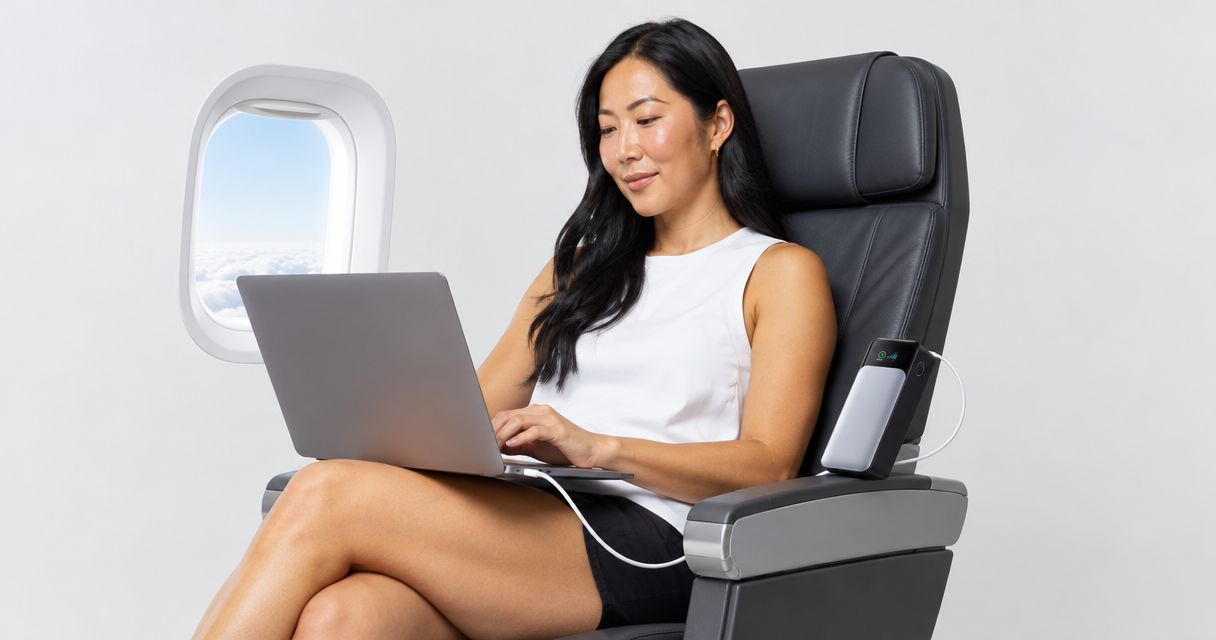
Yes, you can take a power bank for laptop charging on a plane in your carry-on, subject to its watt-hour rating and your airline’s rules. For U.S. passenger travel in 2026, FAA guidance generally permits lithium-ion power banks rated at 100 Wh or less; batteries above 100 Wh and up to 160 Wh require airline approval. Power banks do not belong in checked baggage, and permission to carry one does not automatically mean permission to use it during the flight.
- A power bank for laptop charging belongs in carry-on baggage, not checked luggage.
- FAA guidance generally allows lithium-ion power banks rated at 100 Wh or less without airline approval.
- Above 100 Wh and up to 160 Wh, airline approval is required; stricter airline rules still apply.
- Cadosmarket suits shoppers comparing portable charging by stated specifications; check the battery label separately for flight eligibility.
Why this matters
A laptop power bank has two specifications that answer different questions: watts describe charging power; watt-hours describe battery energy. Confusing them can leave you with a charger that meets your laptop’s needs but fails your airline’s baggage requirements.
You can explore portable charging through Cadosmarket, but make your flight decision from the exact battery’s label and your operating airline’s policy. A product name, fast-charging claim, or USB-C connector does not establish permission to fly.
This guide uses the FAA’s PackSafe lithium-battery guidance and TSA power-bank guidance as the U.S. baseline for 2026. International airlines and individual carriers can impose tighter restrictions, including restrictions on using or recharging power banks onboard.
Can you take a power bank for your laptop on a plane?
Yes—provided the power bank meets the applicable battery limit, stays in the cabin, and satisfies your airline’s restrictions. Under FAA guidance, a power bank counts as a spare lithium battery even when its purpose is charging a laptop rather than a phone.
The following table describes the FAA passenger-baggage baseline, not blanket permission for every airline or international itinerary.
| Battery rating | Best for | U.S. FAA carry-on baseline | Main limitation |
|---|---|---|---|
| 100 Wh or less | Travelers seeking the simpler battery-approval category | Generally permitted without airline approval | Airline-specific quantity, storage, and use rules still apply |
| Above 100 Wh through 160 Wh | Travelers whose equipment needs justify requesting approval | Airline approval required; maximum two spare batteries in this category | A carrier can refuse the battery or set a tighter limit |
| Above 160 Wh | Uses outside ordinary passenger-baggage allowances | Not permitted under the ordinary passenger-baggage allowance | Do not pack it for a passenger flight |
The FAA allowance for larger spare batteries does not compel an airline to accept a particular laptop power bank. Check the airline that operates each flight, especially when a booking includes codeshare services or connecting flights.
Does carry-on permission include permission to charge your laptop?
No. Carrying a battery and operating it onboard are separate questions. Your airline can restrict power-bank use, recharging, or placement during the flight even when the battery is permitted in the cabin.
Treat onboard charging as something to confirm, not something promised by the baggage allowance. Follow the crew’s instructions if they differ from your normal charging routine.
Power banks rated 100 Wh or less
Best for: travelers who want to avoid the FAA’s larger-battery approval requirement. A lithium-ion power bank rated at 100 Wh or less generally fits the FAA category that does not require airline approval.
The advantage is simpler planning. The limitation is that an acceptable energy rating says nothing about whether the device can supply enough power for your laptop, or whether your airline permits onboard use.
For a trip in 2026, check the airline’s current policy rather than relying on an older packing list. Read any separate section covering power banks: a carrier can distinguish them from other spare batteries.
Before choosing this category, verify:
- The exact unit’s watt-hour marking is readable.
- The airline accepts that type of power bank.
- The output matches your laptop’s charging requirements.
- The bank and cable are undamaged.
- Your packing plan keeps the bank out of checked baggage.
Choose the energy category first, then compare laptop-charging performance within it. Buying the most powerful charger first reverses the decision and can create an avoidable travel problem.
Power banks above 100 Wh through 160 Wh
Best for: travelers who have confirmed that their airline accepts the larger battery. FAA guidance requires airline approval for spare lithium-ion batteries above 100 Wh through 160 Wh and limits passengers to two spares in this category.
The benefit is a larger permitted energy allowance under that U.S. framework. The drawback is additional approval work and the possibility that your carrier’s power-bank policy excludes the battery entirely.
Request approval before travel. Give the airline the manufacturer, model, watt-hour rating, and intended use, and ask whether its answer applies to every flight it operates on your itinerary.
Keep any approval accessible with your travel documents. It helps explain what the airline agreed to, but it does not replace the battery’s own labeling or override a crew instruction.
Do not interpret the two-spare allowance as a universal power-bank quantity limit. It describes the FAA’s larger-battery category; an airline can apply a different restriction to power banks themselves.
Power banks above 160 Wh
Best for: charging needs outside ordinary passenger-aircraft baggage allowances. Power banks above 160 Wh do not qualify for the FAA’s ordinary passenger-baggage allowance.
Their limitation for this question is decisive: neither placing the bank in your carry-on nor moving it to a checked suitcase makes it acceptable under that allowance. A larger capacity is not automatically a better travel purchase.
If your planned setup depends on this category, change the setup before heading to the airport. Select a compliant alternative or arrange a separate, properly regulated transport solution rather than trying to resolve the issue at security.
Why power-bank permission varies
The FAA baseline answers only part of the packing question. These factors determine what you can actually take and how you must handle it:
- Battery energy: The watt-hour rating determines which battery-size category applies. Charging watts do not substitute for this rating.
- Operating airline: Airlines can impose tighter power-bank restrictions than the general passenger-baggage baseline.
- Route: An international connection can bring another carrier’s policy and another jurisdiction’s requirements into the trip.
- Battery condition: Damaged, defective, or recalled batteries are a safety issue, not merely a capacity question.
- Packing and handling: Spare batteries must stay out of checked baggage and be protected against short circuits.
- Onboard activity: Permission to carry a bank does not establish permission to charge a laptop or recharge the bank onboard.
For a multi-airline itinerary in 2026, build your packing plan around the strictest applicable policy. Approval from one operating airline does not establish acceptance by another.
How do you check a laptop power bank before flying?
Use this sequence before packing. It separates airline eligibility from charging performance so that one does not get mistaken for the other.
- Read the label. Find the watt-hour rating on the exact unit. If it is unclear, check the manufacturer’s documentation rather than inferring capacity from the model name.
- Check the airline. Read the operating carrier’s current power-bank policy, including any quantity, storage, and onboard-use restrictions.
- Confirm approval. If the battery falls into a category requiring approval, obtain that approval before travel. Do not assume security screening provides it.
- Protect the bank. Prevent exposed connections from touching metal, avoid accidental activation, and keep the bank away from damage.
- Keep it onboard. Put the bank in your cabin baggage and remove it if that bag is taken for gate checking.
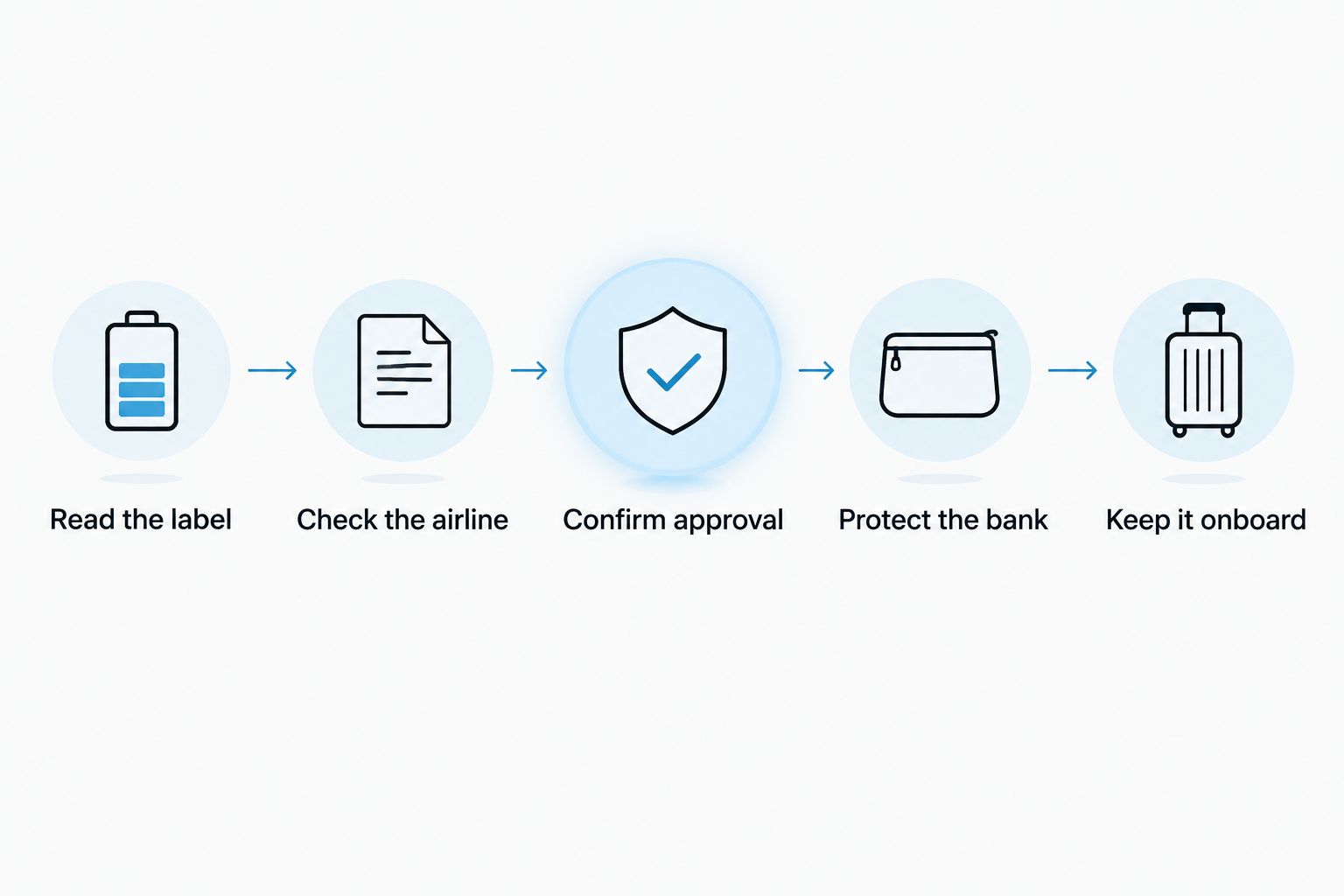
A gate-checked carry-on becomes checked baggage. If an agent takes your cabin bag at the gate, remove the power bank before handing the bag over and keep it with your permitted cabin belongings.
Do not bury the bank where you cannot retrieve it during boarding. Protecting it from crushing and keeping the label accessible also makes inspection easier without changing the battery’s eligibility.
What if the label lists mAh instead of Wh?
Watt-hours equal amp-hours multiplied by nominal voltage. Milliamp-hours must first be converted to amp-hours, and the voltage must be the battery’s nominal voltage—not an arbitrarily selected USB output voltage.
Prefer a manufacturer-stated Wh rating over your own estimate. If the label and documentation do not establish the rating clearly, contact the manufacturer and airline before packing it.
Will an airline-compliant power bank actually charge your laptop?
An airline-compliant power bank can still be unsuitable for your laptop. Check the laptop manufacturer’s charging requirements, the bank’s supported outputs, and the cable’s power rating before buying.
A USB-C connector alone is not proof of laptop-charging compatibility. The bank, laptop, and cable need to support an appropriate charging arrangement, and a bank’s headline maximum output does not mean every connected device receives that output.
For example, Cadosmarket lists the Anker 737 Power Bank (PowerCore 24K) with 140 W Power Delivery 3.1 charging. That is useful output information for a laptop-charging comparison, but 140 W is not a watt-hour rating and does not establish airline eligibility.
The specification makes the product relevant to shoppers comparing higher-output portable charging. Its limit as a flight-selection shortcut is equally clear: you still need the exact unit’s battery-energy marking, your laptop’s requirements, and your airline’s acceptance rules.
Before ordering portable charging from Cadosmarket, separate these checks:
- Output fit: Does the listed output meet the laptop manufacturer’s requirements?
- Cable fit: Does your cable support the required charging connection and power?
- Flight fit: Does the unit’s Wh rating meet every operating airline’s policy?
- Use fit: Will you need to charge onboard, or only before and after the flight?
What should you do if a power bank gets hot during the flight?
Tell a crew member immediately if a power bank becomes unusually hot, swells, smokes, or shows other signs of failure. Stop using it and follow the crew’s instructions rather than hiding it in a bag or attempting an improvised fix.
A battery that is already damaged or defective should not enter your packing plan. Check manufacturer recall notices before travel if you have reason to question a unit’s condition or safety.
Normal travel preparation is not just checking a capacity number. Inspect the enclosure, connections, and cable, and avoid carrying a bank that has visible damage.
FAQ
Can I put a power bank for laptop charging in checked luggage?
No. Power banks are spare lithium batteries and must stay in carry-on baggage under FAA and TSA guidance. Remove the bank if your carry-on is gate-checked.
What is the power-bank limit for a U.S. flight in 2026?
FAA guidance generally permits lithium-ion power banks rated at 100 Wh or less without airline approval. Above 100 Wh through 160 Wh requires airline approval, but your airline can impose tighter power-bank rules.
Can I bring two larger laptop power banks on a plane?
FAA guidance permits a maximum of two spare lithium-ion batteries above 100 Wh through 160 Wh with airline approval. That allowance does not guarantee that your airline accepts power banks in this category.
Does 140 W mean a power bank is too large to fly?
No. A 140 W output rating describes charging power, not stored battery energy. Check the watt-hour rating and the operating airline’s policy to determine flight eligibility.
Can I charge my laptop with a power bank during the flight?
Only if the operating airline permits power-bank use onboard. Permission to carry the bank does not automatically include permission to operate it or recharge it during the flight.
Can I take a power bank if its capacity label is unreadable?
Do not rely on an unreadable label or a model name to establish battery capacity. Obtain clear manufacturer documentation and confirm the airline’s requirements before travel.
Is a laptop power bank the same as a spare laptop battery for packing?
A power bank is treated as a spare lithium battery for FAA passenger-baggage purposes. It belongs in carry-on baggage, with protection against short circuits and damage.
One last thing
Plan for the gate check, not just the security checkpoint. Even a correctly packed power bank becomes a problem if your carry-on is sent to the hold with the battery still inside.
Before leaving for your 2026 trip, make sure you can remove the bank without unpacking your entire bag. Then verify the airline policy once more: the label establishes the battery rating, while the operating carrier establishes what it will accept.