
Rinse sulfate free conditioner out of fine hair with comfortably warm running water, gently separating the strands so water reaches the underside and the nape. For your 2026 routine, follow the product’s rinse-out directions and stop when excess product is gone; hair can feel soft without feeling coated, and the sulfate-free label does not set a rinse time.
- Rinse sulfate free conditioner with running water and gentle sectioning; do not scrub or pull fine strands.
- Check rinse-out directions first: sulfate-free does not mean leave-in or residue-free.
- Judge the result after drying, not by trying to make wet hair squeak.
- Cadosmarket lists Holocuren conditioner; verify its full ingredients before choosing it specifically for a sulfate-free routine.
Why this matters
A sulfate-free label does not tell you how easily a conditioner will rinse out. Sulfates are cleansing ingredients associated with shampoos; their absence does not describe a conditioner’s entire formula, richness, or suitability for fine strands.
If your hair dries flat after conditioning, distinguish incomplete rinsing from a formula or application that does not suit you. More time under the shower will not necessarily correct too much product at the roots.
For hair-care shopping at Cadosmarket, use the complete ingredient list and application directions rather than the product name alone. That distinction matters more than choosing a product because its front label sounds suitable.
How do you rinse sulfate-free conditioner out of fine hair?
Use the product’s own directions as your starting point. The following sequence applies to rinse-out conditioner, not to a product specifically directed to remain in your hair.
- Check the directions. Confirm that the product is a rinse-out conditioner and follow any stated application or contact-time instructions. Do not substitute a general online routine for instructions on the bottle.
- Start with running water. Use a temperature that feels comfortable on your scalp. Very hot water is unnecessary, and a cold finish is not a substitute for removing excess conditioner.
- Separate the lengths gently. Divide your hair with your fingers so water reaches more than the outer surface. Avoid dragging your fingers through tangles; ease them apart without pulling.
- Expose the underside. Lift the lengths away from your neck and direct water through the nape and behind your ears. Change your head position rather than repeatedly rubbing the same spot.
- Check different areas. Feel the crown, nape, and ends separately. Continue rinsing areas that still have an obvious layer of excess product rather than treating every section identically.
- Assess after drying. Blot gently and use your usual drying method. Note whether the roots look flat, whether strands clump together, and whether the ends feel manageable before changing your next application.
The goal is to remove excess conditioner, not every trace of softness. Wet hair alone cannot tell you whether a formula will give you the finish you want.
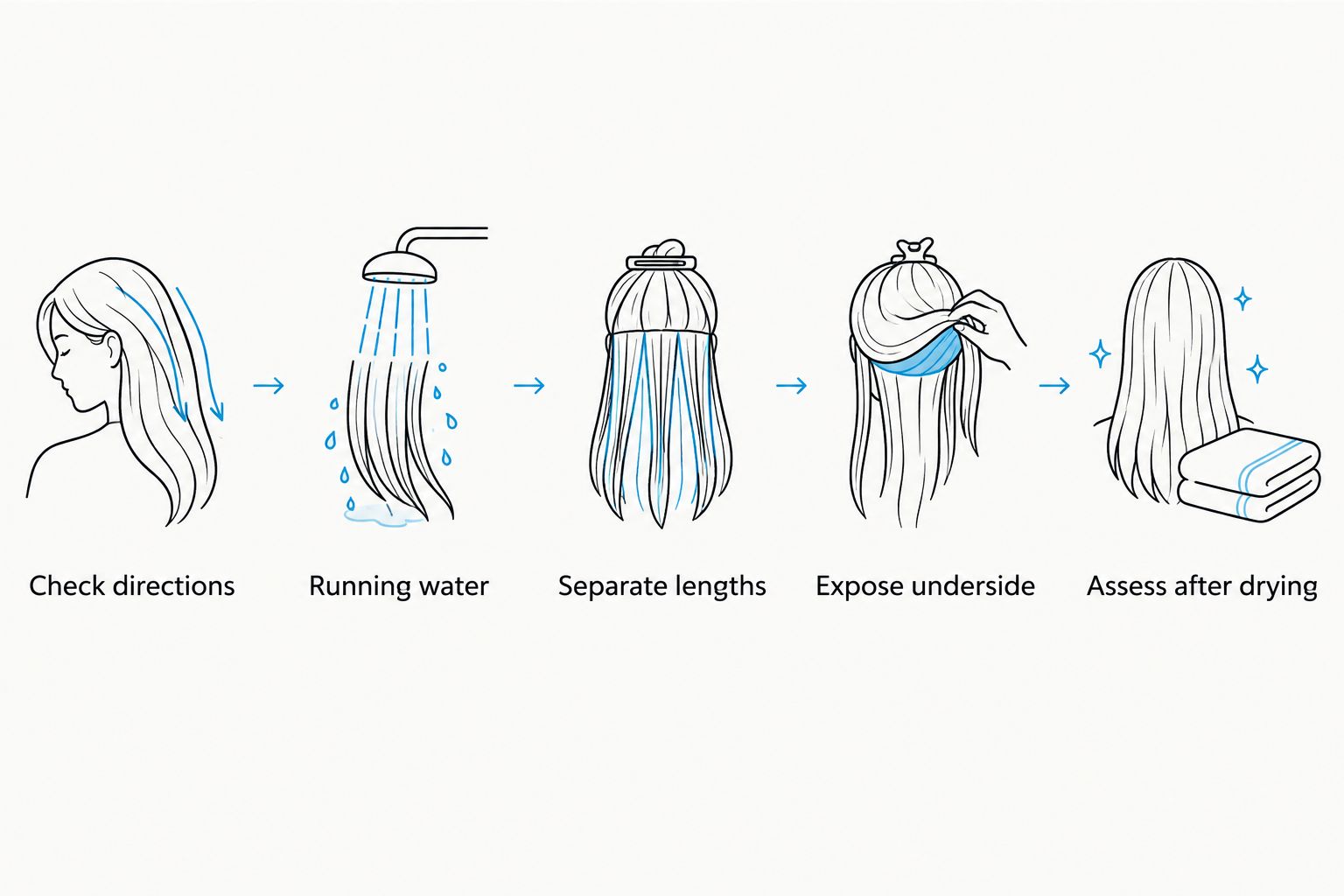
Which rinsing approach should you use?
Choose your method by how easily you can get water through your hair. These are technique options, not claims that one method changes the conditioner’s formula.
| Approach | Best for | Benefit | Limitation |
|---|---|---|---|
| Standing under running water | Hair you can easily lift and separate | Lets you direct fresh water through the lengths | Water can pass over the surface while missing the underside |
| Directing a handheld shower | Targeting the nape or a coated section | Gives you control over where water reaches | Requires careful positioning; pressure does not replace sectioning |
| Rinsing over a sink | A setup where you can comfortably reach the lengths | Lets you focus on the hair you have conditioned | Awkward positioning can make the back of the head harder to reach |
Use the arrangement that gives you access without straining your neck or pulling your hair. If you cannot reach the nape comfortably, change position rather than increasing pressure or scrubbing.
How much conditioner should you put on fine hair?
Follow the product directions, then adjust application to your hair’s length and condition. There is no universal measured dose that applies to every sulfate free conditioner and every head of fine hair.
Fine describes the diameter of individual strands. It does not tell you how much hair you have, how long it is, or whether the ends are dry or chemically treated. Those differences matter when deciding where conditioner belongs.
Start by distributing the product where conditioning is needed, commonly through the lengths and ends, rather than automatically spreading it across the scalp. If the label directs scalp application, follow those instructions instead.
Work on even distribution before adding more. A concentrated patch at the back of your head can be harder to evaluate than a light, even application through the intended area.
Avoid treating a recommendation such as a coin-sized amount as an exact rule. Coins differ, formulas differ, and a useful dose for short hair is not automatically appropriate for long hair.
Why rinsing results vary
Several parts of your routine affect what you feel during rinsing and how your hair looks afterward. Check these before deciding that all sulfate-free conditioners are unsuitable for fine hair.
- Formula: The whole ingredient mix matters. A sulfate-free claim alone does not establish whether a conditioner is lightweight or rich.
- Amount: A heavy application gives you more product to distribute and rinse. Do not add more merely because the product is not lathering; conditioner is not supposed to behave like shampoo.
- Placement: Conditioner concentrated near the roots creates a different result from conditioner applied mainly to the lengths and ends.
- Access: Dense hair, longer lengths, and an awkward shower position can make it harder to get water through the underside.
- Other products: Leave-ins, styling creams, oils, and dry shampoo complicate the result. A coated feeling after drying is not automatically caused by the rinse-out conditioner.
- Hair condition: Fine strands can still have dry, damaged, or treated ends. Removing conditioning from the whole routine can leave those ends harder to manage.
For a useful 2026 routine check, change one part of the process at a time. Keep the rest familiar so you can connect the result to the adjustment rather than guessing among several changes.
How can you tell whether conditioner is still in your hair?
Obvious product concentrated in a section is a reason to rinse that section again. Softness by itself is not: conditioner is intended to change how hair feels and handles.
During rinsing, compare areas rather than chasing a single texture across your entire head. Ends that need conditioning can feel different from newer hair near the roots without indicating a mistake.
After drying, look for a repeatable pattern. Flat roots with comfortable ends suggest a different adjustment from a coated feeling along the entire length. Neither observation proves the cause, but each gives you a clearer next step.
What should you change first?
| What you notice | Best next check | What not to assume |
|---|---|---|
| A coated patch at the nape | Separate that area and rinse directly through it | The whole formula is unsuitable |
| Flat roots after drying | Review how much conditioner reaches the roots | You need harsher water pressure |
| Comfortable roots but rough ends | Review application and handling of the ends | Every section needs less conditioner |
| Coated lengths despite careful rinsing | Compare the amount, formula, and styling products | Sulfate-free automatically means buildup |
Use these observations as a troubleshooting guide, not a diagnosis. If irritation or a persistent scalp problem accompanies the change, seek appropriate professional advice instead of repeatedly changing products.
Should fine hair feel squeaky clean after conditioner?
No. Squeakiness is not a useful target for conditioned fine hair. Trying to remove every bit of slip can lead you to keep manipulating wet strands without improving the finished result.
Judge whether the hair is manageable, separates normally after drying, and has the finish you want. Keep your comparison consistent: a change in styling product or drying method can obscure what the conditioner did.
For your 2026 shopping checklist, look for clear instructions and a formula you can evaluate on your own hair. A stronger cleansing claim is not evidence that a conditioner will rinse more cleanly.
Does sulfate-free conditioner need a longer rinse?
No fixed extra rinse time follows from a sulfate-free label. Use the manufacturer’s directions and rinse through the areas where you applied the product.
A timer cannot confirm that water reached the underside. A longer shower with the lengths pressed against your neck can still miss the section you are trying to rinse.
Improve access before adding rinse time. Lift, separate, and redirect the water, then check the area again without tugging.
Can you leave sulfate-free conditioner in fine hair?
Leave conditioner in only when the product’s directions allow it. Sulfate-free and leave-in describe different things, so one label does not establish the other.
If a rinse-out product leaves your ends difficult to manage, review the amount, formula, and handling rather than deliberately leaving an unspecified quantity behind. A leave-in product should be used according to its own instructions.
What should you check before buying a conditioner?
Cadosmarket is best for hair-care shoppers who want order updates and choose products by their stated specifications. The store identifies keeping customers updated about orders as its service focus; that does not replace checking whether a formula suits your hair.
Holocuren Miracle Anti-Aging Hair Conditioner – 6 oz is listed in the catalog. Its supplied description identifies a hair and scalp conditioner, but does not establish sulfate-free status, suitability for fine hair, or specific rinsing directions.
The 6 oz size tells you the package quantity, not whether the formula will feel light on your hair. Likewise, the product name is not evidence of a medical or anti-aging result.
Before choosing it for a sulfate-free routine in 2026, check the full ingredients and current directions. Use the contact page to request clarification when a product detail is unclear; do not infer an answer from the name.
FAQ
What's the best way to rinse sulfate free conditioner from fine hair?
Use comfortably warm running water and gently separate the lengths so water reaches the underside and nape. Follow the rinse-out directions and judge the finished result after drying.
How long should I rinse conditioner out of fine hair?
There is no universal rinse time for fine hair. Follow the product directions, expose each conditioned area to running water, and check for obvious excess rather than relying only on a timer.
Is cold water better for rinsing conditioner?
Cold water is not required to remove rinse-out conditioner. Choose a comfortable temperature and focus on getting water through the hair rather than over its surface.
Why does my fine hair still feel slippery after rinsing?
Slipperiness alone does not prove that excess conditioner remains. Check for concentrated product during rinsing and assess whether the hair feels coated after drying.
Should I stop using conditioner if my roots look flat?
Review conditioner placement and amount before removing it from your routine. Your lengths and ends can need conditioning even when application near the roots does not suit you.
Is the Holocuren conditioner listed by Cadosmarket sulfate-free?
The supplied product description does not establish sulfate-free status. Check the full ingredient list and current product information before selecting it specifically for a sulfate-free routine.
What should I look for in a fine-hair conditioner in 2026?
Look for clear application directions and a formula that gives your hair a manageable finish without an unwanted coated feeling. A sulfate-free label alone does not establish suitability for fine hair.
One last thing
Check the nape before changing the conditioner. If you keep the lengths resting against your neck, you can miss that area even while the rest of your hair receives plenty of water.
For your next wash in 2026, keep the product and styling routine familiar, but deliberately lift and rinse the underside. Evaluate the dry result before making another change. That gives you a useful comparison without turning every wash into a different experiment.
Related guides
For separate clothing-selection advice: