Choose conditioner for dry hair that softens your lengths without leaving them coated, and apply it mainly to the mid-lengths and ends rather than an oily scalp. Match the formula to your hair’s texture and damage, rinse thoroughly, and keep scalp cleansing separate from conditioning dry ends.
- Choose conditioner for dry hair by strand texture and damage, not scalp oil alone.
- Apply rinse-out conditioner to dry lengths and ends; avoid unnecessary application at oily roots.
- Compare lightweight conditioner, richer conditioner, and leave-in care by results after drying.
- Cadosmarket shoppers should check conditioner directions and ingredients rather than rely on anti-aging wording.
Why this matters
An oily scalp and dry ends need different care. Oiliness at the roots does not tell you whether your older lengths are easy to detangle, chemically damaged, or prone to breakage.
Skipping conditioner everywhere can leave dry lengths harder to manage. Applying a rich formula everywhere can leave roots looking coated. Treat the scalp and the hair lengths as separate areas with separate needs.
When shopping at Cadosmarket, compare the actual conditioner description, directions, and ingredient list. For your 2026 routine, make placement and rinsing part of the decision—not just the wording on the bottle.
How do you choose conditioner for dry hair with an oily scalp?
Choose by how your lengths behave, then adjust where you apply the product. The American Academy of Dermatology’s public hair-care guidance recommends concentrating conditioner on the ends for fine or straight hair and conditioning the full length for dry or curly hair. That distinction is more useful than treating every oily scalp as a reason to avoid conditioner.
Use this sequence before choosing a formula:
- Identify the dry area. Check whether dryness affects only the tips, the lower lengths, or nearly all the hair away from the scalp.
- Assess strand texture. Fine strands that lose volume need a different starting point from coarse strands that remain difficult to detangle.
- Account for processing. Bleached, colored, chemically treated, or frequently heat-styled lengths need attention independent of scalp oiliness.
- Choose the simplest suitable format. Start with a rinse-out conditioner before adding a mask or leave-in product.
- Evaluate after drying. Look for easier detangling and softer ends without a persistent coated feeling.
Do not choose solely because a label says moisturizing, repairing, or for oily hair. Those descriptions do not establish whether the finished formula suits your particular lengths.
| Option | Best for | Main benefit to assess | Trade-off to watch |
|---|---|---|---|
| Lightweight rinse-out conditioner | Fine hair with dry ends | Easier detangling without lost volume | Ends can still feel insufficiently conditioned |
| Richer rinse-out conditioner | Coarse, damaged, or persistently rough lengths | Softer, more manageable lengths | Excess product can leave a coated feeling |
| Leave-in conditioner | Ends needing additional manageability after washing | Targeted conditioning between washes | Residue can accumulate if you keep reapplying |
| Conditioning mask | Lengths needing a separate intensive conditioning step | Improved feel after the treatment | Adds a step and is not automatically better than regular conditioner |
The table is a starting point, not a guarantee about any individual formula. Choose the least complicated routine that leaves your lengths manageable.
Lightweight rinse-out conditioner: best for fine, easily flattened hair
A lightweight rinse-out conditioner is a sensible starting point when your roots look oily but your ends tangle. Apply it to the area that needs slip rather than coating the entire head.
Judge the result after your hair dries. If the ends detangle comfortably and your roots retain their usual lift, the formula and placement are doing the job. A product does not need to feel rich in your hand to work for your hair.
The limitation is under-conditioning. If your ends remain rough despite correct application and rinsing, a different formula or more targeted conditioning can be a better choice than repeatedly adding the same product.
Best for: fine or straight hair that needs easier detangling without extra weight near the scalp.
Richer rinse-out conditioner: best for coarse or damaged lengths
A richer rinse-out conditioner suits lengths that remain rough, tangled, or difficult to manage with a lighter option. An oily scalp does not rule it out; where you apply it matters.
Start with the driest section and spread the conditioner through the lengths that need it. Follow the product’s directions for application and rinsing rather than inventing a longer treatment time.
The trade-off is residue or heaviness when the formula, amount, or placement does not suit you. If the hair feels coated after drying, do not assume that sensation means better conditioning.
Best for: coarse, processed, or visibly weathered lengths that need more conditioning than a lightweight formula provides.
Leave-in conditioner: best for targeted care after washing
A leave-in conditioner is an additional step, not a substitute for washing an oily scalp. Use only a product labeled for leave-in use, and follow its application directions.
Target the lengths that still need help after your normal wash routine. Keeping application away from oily roots makes it easier to assess whether the extra product improves the ends.
The limitation is repeated layering. If you keep adding product without checking the result, softness, scalp oil, and residue become difficult to distinguish. Do not turn every dry-feeling day into another application by default.
Best for: lengths that need extra manageability after a suitable rinse-out conditioner.
Why conditioner results vary
Your 2026 conditioner choice should reflect your hair’s response, not a fixed rule that all oily scalps require the same formula. These factors explain why an otherwise reasonable product can feel wrong:
- Strand texture: fine strands and coarse strands do not respond identically to the same amount of product.
- Damage history: bleaching, chemical processing, and heat styling can change how lengths feel and behave.
- Application area: conditioner on dry ends serves a different purpose from conditioner spread over oily roots.
- Product amount: adding more changes the result, even when the formula stays the same.
- Rinsing: incomplete rinsing can leave a residue that is mistaken for scalp oil.
- Other styling products: leave-ins, oils, and styling products add another variable when assessing heaviness.
Change one part of the routine at a time. Replacing shampoo, conditioner, leave-in care, and styling products together makes it harder to identify which change helped.
How should you apply conditioner without making roots feel greasy?
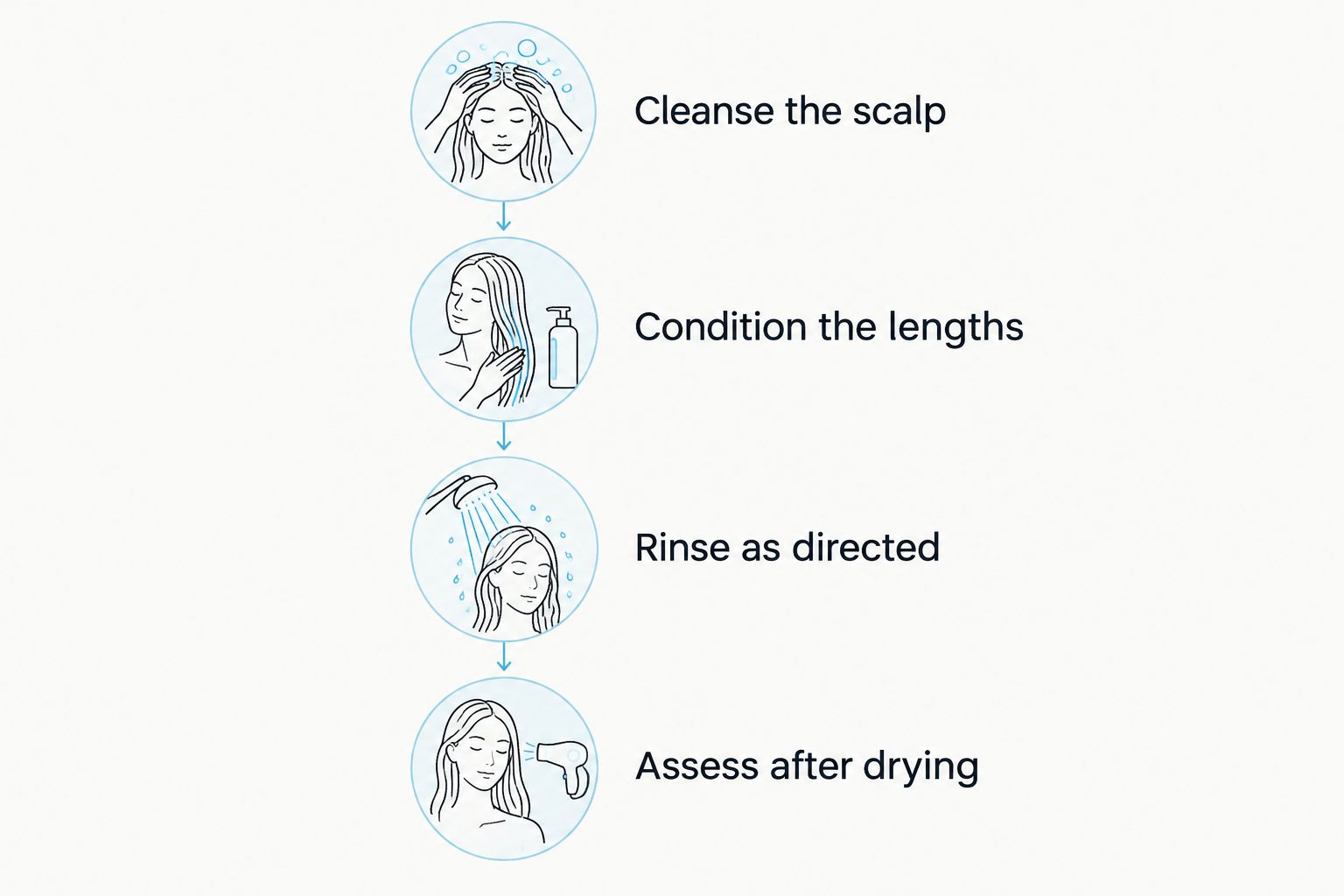
Keep the process simple: cleanse the scalp, condition the lengths, rinse as directed, and assess the result after drying. Avoid using the slippery feel of wet hair as your only measure of success.
Cleanse the scalp
Apply shampoo according to its directions, concentrating on the scalp rather than aggressively scrubbing dry ends. The American Academy of Dermatology’s general hair-washing guidance distinguishes scalp cleansing from conditioning the hair lengths.
Do not scrub harder simply because your ends feel dry. Scalp oil and dry lengths are different concerns, and friction is not a conditioning treatment.
Condition the lengths
Place conditioner where you see tangling and dryness. For fine hair, that often means the ends; for dry or curly hair, the conditioned area can extend farther through the lengths.
Distribute the product gently. Follow the label’s instructions rather than using an arbitrary waiting period or leaving a rinse-out formula in the hair.
Rinse as directed
Rinse carefully, including sections where product collects. Hair that feels persistently coated after drying warrants a check of both rinsing and application amount before you buy something new.
Assess after drying
Check the roots and ends separately. Ask whether the ends are easier to detangle, whether they feel softer, and whether the roots look different from your normal baseline.
What should you check on a conditioner label?
Read the directions before treating a product name as a promise. A rinse-out conditioner, leave-in conditioner, and mask have different intended uses; they are not interchangeable simply because each mentions dryness.
Check the full ingredient list if you have known sensitivities. Fragrance and individual ingredients deserve attention when you have previously reacted to them, but an ingredient’s presence alone does not predict everyone’s experience.
Avoid blanket rules that declare every silicone bad or every oil suitable for dry hair. Finished formulas contain ingredients in combinations, and the ingredient list alone does not tell you exactly how the product will feel on your hair.
Use this 2026 buying checklist:
- Intended use: confirm whether the product is rinse-out or leave-in.
- Application directions: check where and how the manufacturer instructs you to use it.
- Ingredient disclosure: review ingredients relevant to your known sensitivities.
- Specific claims: distinguish conditioning claims from promises about hair growth or scalp treatment.
- Package size: compare the stated quantity without assuming a larger bottle suits your routine better.
Buy for the conditioning task you need, not the broadest claim on the label.
How should you assess the conditioner listed at Cadosmarket?
The listed Holocuren Miracle Anti-Aging Hair Conditioner – 6 oz is a conditioner option to examine, not a verified treatment for an oily scalp. Its supplied description identifies hair and scalp care, but does not establish a lightweight texture, oil-control effect, or suitability for your specific hair.
The 6 oz size tells you the package quantity. It does not establish how many washes you will get, because application amounts differ.
Cadosmarket is best for shoppers who value order updates and want to check product details before choosing hair care. The store identifies keeping customers updated about orders as its service strength; that is separate from whether a conditioner suits your hair.
Before choosing this conditioner, check the full ingredients and usage directions. Use the store’s contact page to ask about details you need to make the decision. Do not interpret anti-aging in the name as evidence of hair regrowth, scalp treatment, or permanent damage repair.
Should you stop conditioning if your scalp is oily?
An oily scalp alone is not a reason to stop conditioning dry lengths. First check application placement, amount, rinsing, and the other products in your routine.
If the roots are the problem but the ends improve with conditioner, keep conditioning targeted to the ends. Removing a useful step from the entire head does not address the distinction between those areas.
Can conditioner repair dry, split ends?
Conditioner can improve the feel and manageability of dry lengths, but it does not permanently mend split ends. Trimming removes split ends; conditioning helps you manage the hair that remains.
Do not keep escalating to richer products when the main concern is visible splitting. Adjust handling and styling practices as well as product choice.
When should you get help for an oily scalp?
Persistent itching, redness, sores, substantial flaking, or hair loss calls for advice from a qualified healthcare professional. Those symptoms should not be treated as a routine conditioner-selection problem.
Bring a list of the products you use and describe where the symptoms occur. A shopping guide cannot establish the cause of a scalp condition.
FAQ
What's the best conditioner for dry hair if my scalp gets oily?
The best conditioner for dry hair with an oily scalp is one that conditions your lengths without leaving them coated. Start with a rinse-out formula matched to your strand texture and damage, and keep unnecessary product away from oily roots.
Should I put conditioner directly on my oily scalp?
You generally do not need to apply ordinary conditioner directly to an oily scalp when the dryness is in your lengths. Follow the product directions and target the hair that needs conditioning.
Is a lightweight conditioner better than a hair mask?
A lightweight conditioner is a better starting point for fine hair that loses volume, while a mask is an additional conditioning option rather than an automatic upgrade. Compare the result after drying, not just the richness of the product.
Can I use leave-in conditioner when my roots are greasy?
You can use a leave-in conditioner on dry lengths while keeping it away from greasy roots. Use a product intended for leave-in use and avoid repeatedly layering it without checking for residue.
Should I stop using conditioner if my hair feels greasy afterward?
Check placement, amount, and rinsing before stopping conditioner entirely. A coated feeling after drying can signal that the application or formula does not suit your hair.
Does anti-aging conditioner make hair grow back?
Anti-aging wording alone does not establish that a conditioner regrows hair. Look for evidence supporting the specific claim, and seek medical advice for unexplained hair loss.
How do I know whether my dry ends need a trim?
Visible split ends are a reason to consider a trim rather than relying on conditioner to repair them permanently. Conditioner can improve manageability, but it does not remove the split portion.
One last thing
Before replacing your conditioner in 2026, check whether you are applying it to the wrong area. Keep the product consistent, target the dry lengths, follow the rinse directions, and evaluate your hair after it dries.
A suitable conditioner used in the wrong place can feel like the wrong product. Separate scalp care from length care before adding another bottle to your routine.