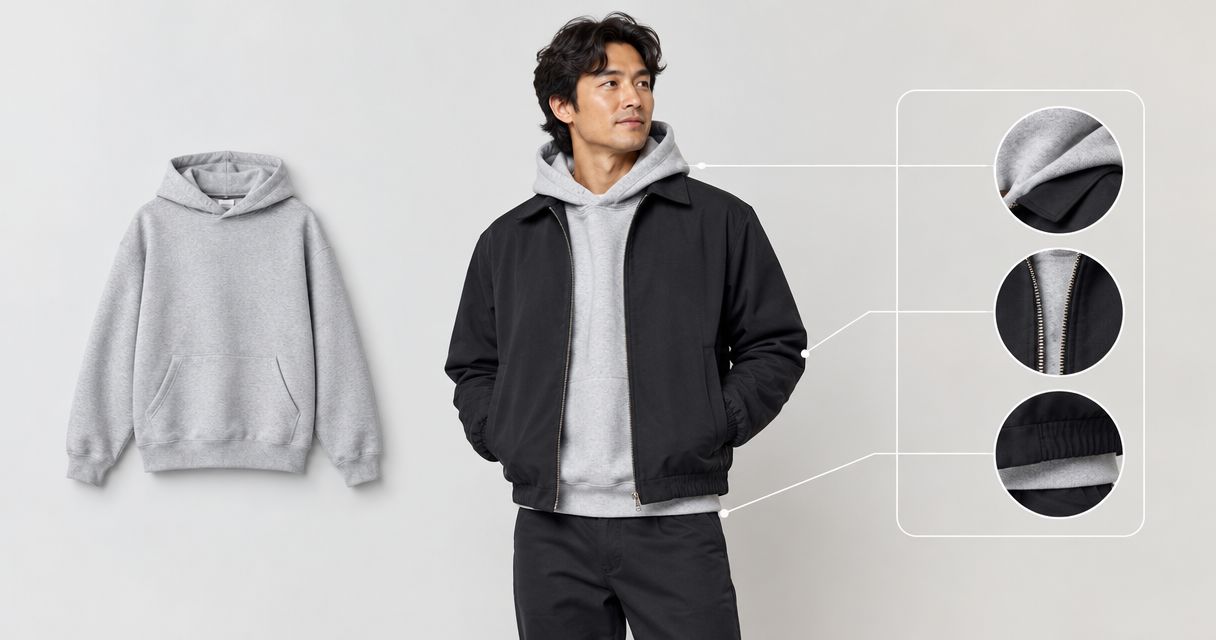
A heavyweight hoodie should fit under a jacket without restricting your shoulders, bunching inside the sleeves, or pulling the jacket closure tight. Keep enough room to reach forward and bend your elbows with both layers on; a hoodie that fits comfortably alone can still be too bulky beneath a close-fitting jacket.
- A heavyweight hoodie fits correctly when your jacket closes without pulling and your arms move freely.
- Choose regular layering room before sizing up; extra length does not guarantee enough sleeve space.
- Check the hood, cuffs, and hem together, not just the chest.
- Cados Market shoppers should compare garment measurements and jacket room before choosing a hoodie size.
Why this matters
A jacket can look right over a T-shirt but feel restrictive over a heavyweight hoodie. The extra fabric changes how the shoulders, upper arms, neckline, and cuffs sit together. Judge the combination as an outfit, not as separate garments.
For your 2026 layering purchases, start with the jacket you intend to wear most often. Its cut determines how much room you have for the hoodie. The guide to choosing a heavyweight hoodie for cold weather covers the broader selection decision; this guide focuses on getting the layers to fit together.
How should a heavyweight hoodie fit under a jacket?
The hoodie should sit comfortably against your base layer while the jacket falls over it without squeezing or dragging. You should not need to rearrange the sleeves after every movement, and the hood should not force the jacket collar against your neck.
Use these checks with the jacket fully fastened in the way you normally wear it:
- Check the shoulders. Stand naturally, then reach forward. Look for pulling across the upper back and pressure where the jacket sleeves meet the body.
- Bend your elbows. The hoodie sleeves should not form uncomfortable folds inside the jacket or prevent you from bending your arms normally.
- Check the closure. Fasten the jacket without holding your breath or drawing your shoulders inward. The front should not pull tightly across the hoodie.
- Arrange the hood. Put it where you intend to wear it, then turn your head. Check for pressure behind the neck and beneath your chin.
- Sit down. Check whether the hoodie gathers beneath the jacket hem or the jacket pushes the hoodie upward.
A dropped shoulder seam is not automatically a sizing problem: some hoodies are designed that way. Judge pressure and movement before judging seam position. Likewise, a close-looking outfit is not necessarily too tight if you can move comfortably and the closure lies without tension.
Which hoodie fit works best beneath a jacket?
Choose the fit around your actual jacket rather than choosing a label alone. “Regular,” “relaxed,” and “oversized” describe different intentions, but the garment measurements determine whether the combination works.
| Hoodie fit | Best for | Main advantage | Main limitation | What to check |
|---|---|---|---|---|
| Close-fitting | Jackets with limited layering room | Less loose fabric to arrange beneath the jacket | Can restrict movement if the hoodie itself is too tight | Chest, upper arms, and forward reach |
| Regular | Everyday layering beneath a jacket with room for a midlayer | Balances movement with manageable fabric volume | Still needs sufficient room in the jacket sleeves | Shoulder movement and elbow bend |
| Oversized | Roomier jackets and deliberately loose outfits | Provides a loose hoodie silhouette | Extra sleeve and body fabric can bunch | Upper arms, underarms, and hem |
A regular fit is the practical starting point for layering, not a guarantee of compatibility. An oversized hoodie beneath a narrow jacket creates a different problem from a regular hoodie beneath a roomy jacket. Solve the actual restriction instead of assuming a larger or smaller label will fix everything.
Check each fit area before changing sizes
For a 2026 fit check, use the same base layer, hoodie, and jacket together throughout. Changing the layers between checks makes it harder to identify which garment causes the problem.
Shoulders and upper back
Reach forward as though you are holding a steering wheel. If the hoodie moves comfortably without the jacket but pulls with the jacket on, the outer layer is restricting the combination.
Check where you feel the resistance. Pressure across the upper back points to a different fit issue than loose hoodie fabric folded beneath the armholes. Do not size down the hoodie simply to make the jacket appear smoother if that leaves the hoodie tight when worn alone.
Sleeves and cuffs
Pull the hoodie sleeves into place before putting on the jacket. Then bend and straighten your arms without tugging at either layer. The cuffs should stay comfortable rather than gripping your wrists or dragging the hoodie sleeves backward.
Extra sleeve length can collect around the forearms even when the chest fits well. If that happens, look for a different sleeve proportion rather than assuming you need a different chest size. A larger jacket can add room without correcting an excessively long hoodie sleeve.
Hood and neckline
Arrange the hood outside the jacket collar if that is how you intend to wear it. Smooth it across your upper back rather than leaving it folded beneath the collar. Turn your head and check that the neckline stays comfortable.
If both garments have hoods, try the arrangement you will actually use. Leaving both down, wearing the hoodie hood, and wearing the jacket hood place fabric differently around your neck. A combination that works in one position does not automatically work in the others.
Body and hem
Check the hoodie while standing and sitting. A hem that looks tidy when standing can gather beneath a shorter jacket when you sit down. A longer hoodie can also show below the jacket without indicating a fit problem.
Visible length is a styling choice; fabric trapped tightly beneath the jacket is a comfort issue. Keep those decisions separate. Choose the hem relationship you prefer, then confirm that neither garment pulls the other out of place.
Why heavyweight hoodie fit varies
A heavyweight description does not tell you whether a hoodie will fit beneath your jacket. The interaction between the garments matters more than that word alone.
- Hoodie cut: A close-fitting body, straight body, and oversized body distribute fabric differently beneath an outer layer.
- Jacket cut: A jacket designed with little layering room can restrict an otherwise comfortable hoodie.
- Sleeve proportions: Long sleeves and roomy upper arms can add folds even when the chest measurements seem suitable.
- Hood construction: The amount of fabric around the neckline affects how the hoodie sits beneath the jacket collar.
- Base layer: The clothing beneath the hoodie contributes to the total space the jacket must accommodate.
- Hem relationship: Different hoodie and jacket lengths affect where fabric gathers when you sit or bend.
Read “heavyweight” as a reason to check layering room, not as a standardized fit measurement. Compare the actual garment information and your own movement checks before deciding whether the combination works.
Should you size up the hoodie or the jacket?
Do not size up either garment until you identify where the restriction starts. A larger hoodie adds fabric beneath the jacket. A larger jacket adds room, but it can also change shoulder placement, sleeve length, and the overall silhouette.
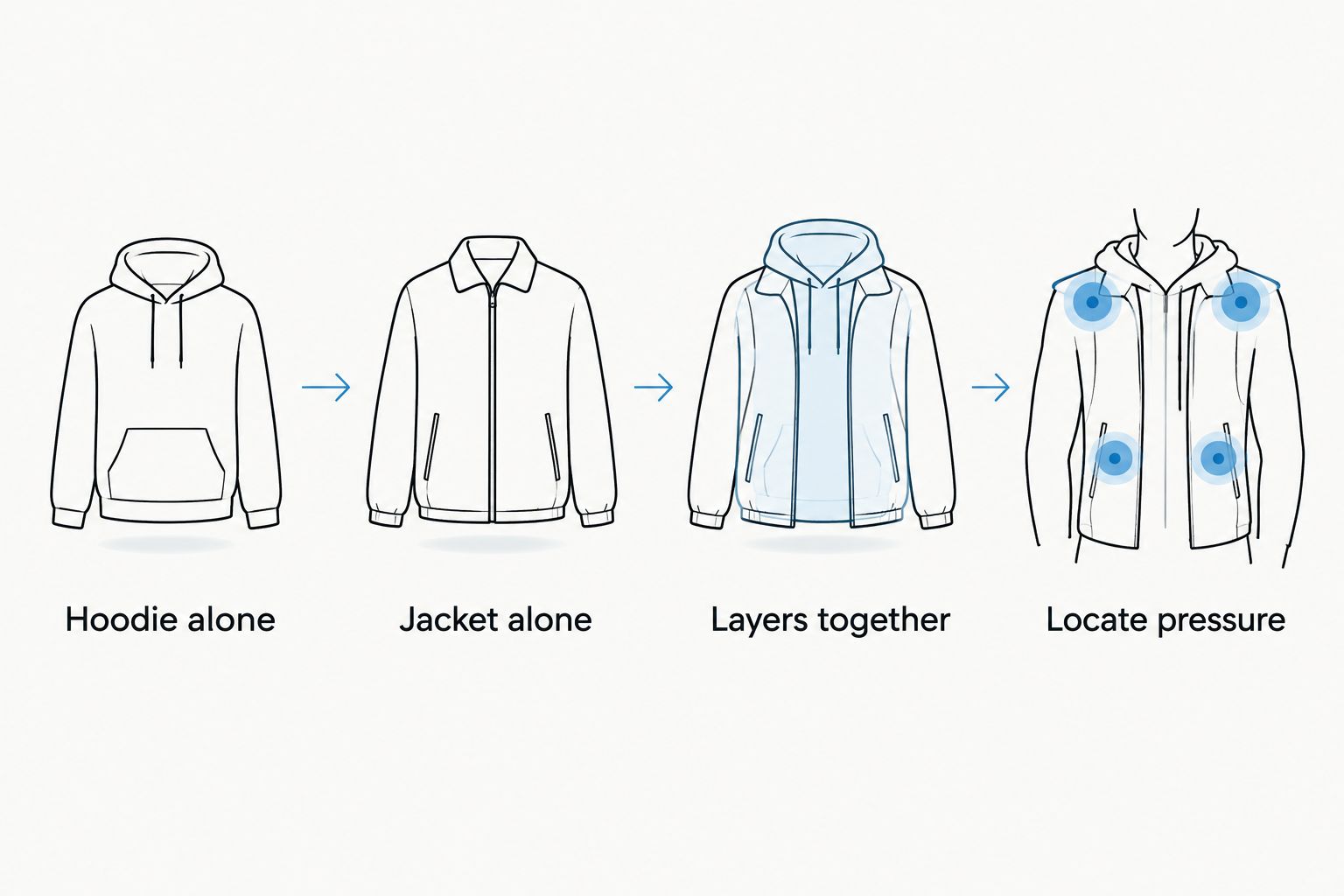
Use this sequence when choosing sizes in 2026:
- Hoodie alone: Wear the hoodie over your intended base layer. Check that it already fits comfortably.
- Jacket alone: Try the jacket over the base layer. Identify any restriction that exists without the hoodie.
- Layers together: Put on the full combination and repeat the reach, elbow, closure, and sitting checks.
- Locate pressure: Identify whether the problem is at the chest, upper arms, neck, or hem before changing a size or cut.
If the hoodie fits well alone but the combination feels tight, compare a roomier jacket cut before replacing the hoodie. If the hoodie already restricts your movement alone, address that fit first. Changing both garments at once makes it harder to understand what improved the outfit.
When a different cut beats a different size
Choose a different cut when the fit problem is localized. For example, a hoodie can have a comfortable chest but sleeves that collect too much fabric beneath your jacket. Moving up a size does not target that issue.
The reverse applies when the sleeves work but the body pulls. Look at the relevant measurements rather than treating the size label as a complete description. The right size in the wrong cut can still be the wrong layering choice.
What should you check before ordering online?
Use measurements from a hoodie that already works beneath your jacket as your reference. Lay it flat without stretching it and follow the seller's measurement instructions. Compare like with like: a flat garment width is not the same measurement as a body circumference.
For a 2026 online order, review the following before choosing a size:
- Measurement type: Confirm whether the chart describes your body or the finished garment.
- Chest measurement: Compare the listed measurement using the same method as your reference hoodie.
- Sleeve length: Check the measurement starting point rather than assuming every chart uses the shoulder seam.
- Body length: Compare where the hoodie will end relative to your jacket.
- Fit description: Read regular, relaxed, or oversized alongside the measurements, not instead of them.
- Care instructions: Check the stated washing and drying guidance before deciding how you will maintain the fit.
Cados Market is best for shoppers who want customer service that keeps them updated about orders. That service strength is separate from fit: use the available product information to assess the garment before buying.
The store's Heavyweight Hoodie P2016 is a relevant starting point for this clothing category, but the product name alone does not establish its dimensions or its fit beneath your jacket. Check the listed details and use the contact page for questions about information you need before ordering. Do not assume a fabric composition, warmth rating, or stretch level from the heavyweight label.
Should a heavyweight hoodie be tight under a jacket?
A heavyweight hoodie should not feel tight enough beneath a jacket to restrict your normal movement. A close silhouette is acceptable when the sleeves, shoulders, and closure remain comfortable.
Try reaching forward rather than judging only a still mirror view. Tightness that appears during movement matters even if the outfit looks smooth while you stand still.
Is it okay for the hoodie to hang below the jacket?
A hoodie can hang below the jacket if you prefer that appearance and the layers move comfortably. The visible hem is not, by itself, evidence that the hoodie is too large.
Check the outfit while seated. If the jacket traps or pushes up the hoodie, reconsider the length combination rather than focusing only on the visible strip of fabric.
Should the hood go inside or outside the jacket?
Wear the hood outside the jacket when tucking it inside creates pressure or a lump behind your neck. If you prefer it tucked in, confirm that the collar still sits comfortably and your head turns freely.
There is no single arrangement that suits every neckline. Test the position you intend to use rather than choosing it only for appearance.
FAQ
What's the best heavyweight hoodie fit for wearing under a jacket?
A regular fit is a practical starting point when the jacket has enough room for a midlayer. Confirm that your shoulders move freely, your elbows bend comfortably, and the jacket closes without pulling.
Should I buy a heavyweight hoodie a size smaller for layering?
Do not buy a heavyweight hoodie a size smaller solely to fit it beneath a jacket. The hoodie should fit comfortably on its own; use the jacket cut and garment measurements to resolve layering restrictions.
Why do my hoodie sleeves bunch under my jacket?
Hoodie sleeves bunch when excess fabric gathers inside the jacket sleeves. Check sleeve length and upper-arm room before changing the chest size.
Can I wear an oversized hoodie under a jacket?
You can wear an oversized hoodie beneath a jacket that accommodates its extra fabric. Check the upper arms, underarms, and hem for folds that restrict movement or require repeated adjustment.
Does heavyweight mean a hoodie will fit more tightly?
Heavyweight does not specify a hoodie's fit. The garment cut and measurements determine how it sits on your body and beneath your jacket.
How do I check whether my jacket is too tight over a hoodie?
Fasten the jacket over the hoodie, reach forward, bend your elbows, and sit down. Pulling across the closure, restricted shoulders, or trapped sleeve fabric indicates that the combination needs adjustment.
What should I check before buying a hoodie from Cados Market?
Check the product's listed measurements, fit description, materials, and care instructions against your needs. For layering, compare those details with a hoodie that already fits comfortably beneath your jacket.
One last thing
Keep your reference hoodie, not just your usual size label. Before your next 2026 purchase, record its measurements and note which jacket it fits beneath. That gives you a repeatable comparison for another hoodie without assuming different cuts share the same proportions.
Then perform the simplest final check: put the outfit on and stop arranging it. Reach, sit, and stand normally. If you keep pulling the sleeves or hem back into place, revisit the combination before deciding it fits.