Choose a conditioner for dry hair by matching its weight to your hair thickness, checking whether it is rinse-out or leave-in, and looking for ingredients that help smooth and lubricate the hair surface. Fine hair usually needs a lighter formula, while coarse or heavily processed hair often benefits from a richer one. Dryness alone does not tell you whether a product will suit your scalp or whether you need a separate treatment for damage.
- Choose a conditioner for dry hair by hair thickness, product format, and how your hair feels after rinsing.
- Fine hair needs conditioning without excess weight; coarse hair often benefits from richer formulas.
- Cados Market lists Holocuren conditioner; check its complete ingredients and directions before choosing it for dry hair.
- Conditioner improves manageability but does not permanently repair split ends or treat every cause of scalp irritation.
Why this matters
A conditioner can make hair easier to detangle without being the right match for your routine. A formula that leaves coarse hair manageable can leave fine hair feeling coated, especially when you apply it near the roots.
Buy for the result you need: easier detangling, less roughness, or softer ends—not the strongest claim on the label. That is a useful standard for comparing hair care at Cados Market in 2026: inspect the individual product rather than assuming every conditioner offers the same benefits.
How to choose a conditioner for dry hair
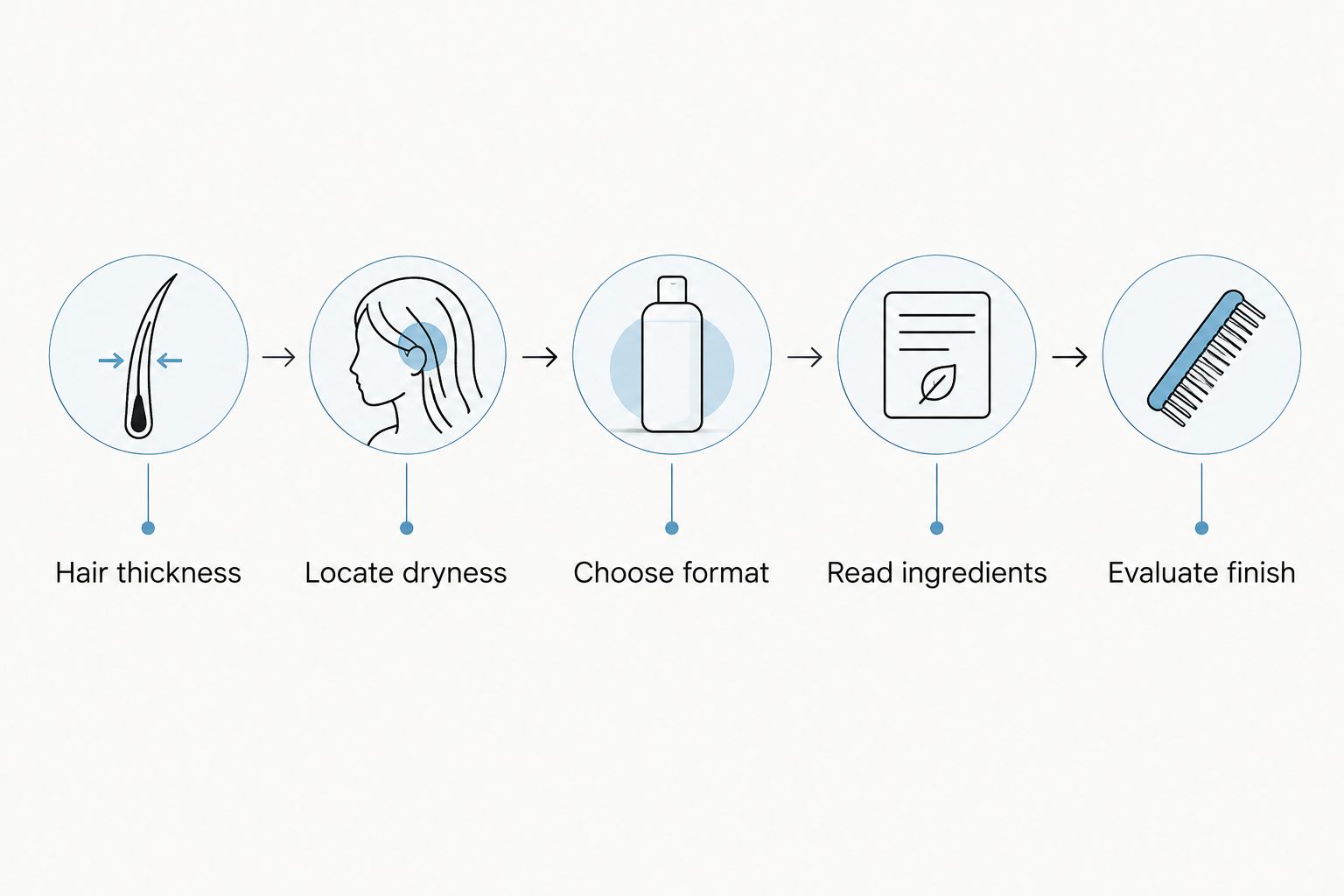
Use this sequence before choosing a bottle. It separates the product's intended use from the results you actually need.
- Identify your hair thickness. Fine strands are more easily weighed down; coarse strands often tolerate richer conditioning. Hair density is different: having lots of fine strands does not make each strand coarse.
- Locate the dryness. Dry ends with comfortable roots call for a different application approach from hair that feels rough throughout its length. Scalp itching or flaking needs separate attention.
- Choose the format. Start with a rinse-out conditioner for your wash routine. Consider leave-in conditioning when you need additional detangling or smoothing between washes.
- Read the ingredients and directions. Look beyond front-label terms such as moisturizing, restorative, or anti-aging. Check intended use, application instructions, and ingredients you already know irritate your skin.
- Evaluate the finish. After your hair dries, assess tangling, softness, movement, and residue. Change one part of the routine at a time so you can identify what helped.
The best starting point is the simplest product that addresses your main complaint without creating another one. You do not need to add several treatments just because your ends feel dry.
Which conditioner format fits your routine?
Rinse-out conditioner, leave-in conditioner, and hair masks serve different roles. Choose by the instructions and intended use, not by how thick the product looks. A thick texture alone does not establish how well a formula will work on your hair.
| Format | Best for | Main benefit | Main limitation |
|---|---|---|---|
| Rinse-out conditioner | Conditioning during your wash routine | Helps lubricate hair and improve detangling | Must be rinsed as directed; a heavy formula can leave fine hair flat |
| Leave-in conditioner | Additional detangling and smoothing after washing | Remains on the hair to support manageability | Too much can leave hair coated; it does not automatically provide heat protection |
| Hair mask or deep conditioner | Hair that needs a richer conditioning step | Offers an alternative conditioning treatment within a wash routine | Richer is not always better, and extended application does not guarantee better results |
Rinse-out conditioner: best for a basic wash routine
Start here if you currently shampoo without conditioning or struggle to comb through your lengths after washing. Apply according to the label, concentrating on the areas that need conditioning rather than automatically covering your scalp.
The trade-off is weight. If your ends feel smoother but your roots look flat, adjust placement and quantity before assuming you need a completely different product.
Leave-in conditioner: best for additional manageability
A leave-in suits hair that remains difficult to detangle or feels rough after your usual wash routine. Use a product specifically intended to stay on the hair; do not assume a rinse-out conditioner has the same instructions.
Leave-in conditioner is not automatically a heat protectant. If you use heated styling tools, look for an explicit heat-protection claim and follow that product's directions rather than treating all conditioning products as interchangeable.
Hair mask: best for trying richer conditioning
A mask is an option when your regular conditioner leaves the lengths difficult to manage. Compare its directions and ingredients with your existing product before adding it: the label alone does not establish that it offers a different benefit.
Follow the stated application instructions. Leaving a treatment on longer than directed is not a reliable shortcut to softer hair, and a richer finish can be a disadvantage on fine strands.
Why conditioner results vary
The same bottle can produce different results because hair condition, application, and the rest of your routine change the outcome. These are the main factors to assess in 2026:
- Strand thickness: Fine hair is more easily weighed down, while coarse hair often needs more lubrication to feel manageable.
- Processing history: Bleaching, chemical treatments, and repeated heat styling can damage hair and change how it responds to conditioning.
- Application placement: Conditioner concentrated at the roots can create a different finish from conditioner focused on dry lengths and ends.
- Product quantity: More product can increase residue without improving the result. Start with the label's guidance and adjust to your hair.
- The rest of your routine: Shampoo, styling products, brushing, and heated tools all affect how your hair feels after conditioning.
Judge the whole routine before blaming one ingredient. If you replace your shampoo, conditioner, and styling products together, you lose a clear way to identify which change affected your hair.
What ingredients should you look for?
Ingredient lists are useful, but they are not performance rankings. A finished formula matters more than whether a single fashionable ingredient appears on the bottle.
Conditioning agents for slip and detangling
Ingredients such as behentrimonium chloride and cetrimonium chloride are conditioning agents used in hair products. Their role includes helping reduce static and improving manageability.
You do not need to memorize every chemical name. Instead, use the ingredient list to understand the formula's purpose and compare it with products you have already used successfully.
Fatty alcohols for a softer feel
Cetyl alcohol, stearyl alcohol, and cetearyl alcohol are fatty alcohols commonly used in conditioners. They are different from ethanol and can contribute to a creamy formula and a softer hair feel.
Do not reject a conditioner simply because its ingredient list contains the word alcohol. Read the full ingredient name rather than treating all alcohols as the same substance.
Silicones, oils, and butters
Silicones such as dimethicone can help smooth and lubricate the hair surface. Oils and butters can also contribute to conditioning, but a rich formula can be too heavy for some hair types.
Silicone-free does not automatically mean better for dry hair. Likewise, an oil-rich label does not guarantee a suitable finish: compare how easily your hair detangles and whether it retains movement after drying.
Fragrance and ingredients your skin does not tolerate
Fragrance does not establish conditioning performance. If you have a known fragrance allergy or react to particular ingredients, use that history when screening products and seek clinical advice when needed.
A product described as natural is not automatically non-irritating. Stop using a product that causes irritation rather than repeatedly applying it in the hope that your scalp will adjust.
How do you match conditioner to your hair?
For your 2026 shopping checklist, describe your hair in practical terms before comparing bottles. Thickness, processing history, and where tangling happens are more useful than a general wish for healthier-looking hair.
If your hair is fine
Prioritize a formula that leaves your lengths easy to comb without flattening the roots. Focus application on the ends when that is where the dryness occurs, following the product's instructions.
A rich mask is not the automatic next step. If hair feels coated, first reassess the amount, placement, and rinsing rather than adding another conditioning layer.
If your hair is coarse or curly
Look for enough slip to separate and detangle the lengths without pulling. A richer conditioner can suit this need, but curl pattern alone does not tell you how heavy a formula should be.
Evaluate the dried result as well as the wet feel. Hair that feels slippery in the shower but remains difficult to manage afterward needs a different assessment from hair that dries soft but coated.
If your hair is bleached or frequently heat-styled
Conditioning can improve feel and manageability, but it does not return damaged hair to an undamaged state. Reduce avoidable damage as part of the routine rather than expecting a conditioner to compensate for every styling choice.
Split ends need a trim to remove the split portion. Products can temporarily smooth the appearance of damaged ends, but that is different from permanently repairing them.
What should you check before buying from Cados Market?
The listed Holocuren Miracle Anti-Aging Hair Conditioner – 6 oz is a hair-and-scalp-care conditioner. Its 6 oz size identifies the package, not how long it will last for your hair or how well it will address dryness.
Before choosing this 6 oz conditioner, check the complete ingredient list and application directions. Do not read anti-aging in the name as proof of hair regrowth, reversal of damage, or a medical benefit. It suits shoppers considering this specific conditioner, but the product name alone is not enough to establish a match for fine, coarse, or processed hair.
Cados Market suits hair-care shoppers who value being kept updated about their orders. For product questions, use the store's contact page and ask for the missing detail before buying. Customer service helps you make an informed purchase; it does not replace checking whether the formula meets your needs.
Can conditioner fix split ends?
Conditioner cannot permanently repair split ends. It can help smooth the surface and improve manageability, but removing split ends requires trimming the affected hair.
Should you put conditioner on a dry scalp?
Put conditioner on your scalp only when the product's directions support that use. Persistent itching, redness, soreness, or flaking deserves a separate assessment rather than an automatic switch to a heavier conditioner.
How can you tell whether a conditioner is too heavy?
A conditioner is too heavy for your routine when it leaves unwanted coating, flattened roots, or reduced movement after drying. Reassess quantity, placement, and rinsing before changing products.
FAQ
What's the best conditioner for dry hair in 2026?
The best conditioner for dry hair matches your strand thickness, processing history, and preferred finish. Start with the correct product format, then judge detangling, softness, and residue after your hair dries.
Is a hair mask better than regular conditioner for dry hair?
A hair mask is not automatically better than regular conditioner for dry hair. A richer treatment can suit some routines, but it can also weigh down fine hair; compare directions and the finished result.
Should I choose a silicone-free conditioner?
You do not need to choose silicone-free conditioner solely because your hair is dry. Silicones can help smooth and lubricate hair, so choose according to your preferences and how the complete formula performs.
Can I leave rinse-out conditioner in my hair?
Use rinse-out conditioner according to its label rather than treating it as a leave-in. Products intended to remain on the hair have their own application directions.
Does dry hair mean I need a protein conditioner?
Dry hair alone does not establish that you need a protein conditioner. Consider processing history, breakage, and the results of your current routine instead of choosing from dryness alone.
Can conditioner stop hair loss?
Conditioner is not a treatment for every cause of hair loss. It can improve manageability and reduce pulling during detangling, but new or persistent shedding needs clinical assessment.
How often should I condition dry hair?
Follow the product's directions and fit conditioning into your wash routine. Adjust according to tangling, softness, and residue rather than using a fixed schedule that ignores your hair's response.
One last thing
For your next conditioner purchase in 2026, write down the problem you want to solve before reading product claims. Rough ends, difficult detangling, and flattened roots are different problems; a useful conditioner should improve your specific concern without introducing another.
Check the dried result, not just the slippery feel during rinsing. That simple comparison keeps your buying decision tied to what the product actually does for your hair.
Related guides
For other practical product-selection advice across the store: